Bilderberg/1973
Saltsjöbaden, Sweden
<- | |
|---|---|
| File:Bilderberg 1973.png The 1973 Bilderberg Report | |
| Date | 11 May 1973 - 13 May 1973 |
| Location | Saltsjöbaden, Sweden |
| Description | The meeting at which the 1973 oil crisis appears to have been planned. |
| Perpetrators | Bilderberg/Steering committee |
| Participants | Bernhard von Biesterfeld, Ernst H. van der Beugel, Joseph E. Johnson, C. Frits Karsten, Giovanni Agnelli, Robert O. Anderson, George Ball, Wilfrid S. Baumgartner, Frederic Bennett, Selahattin Beyazit, M. Nuri Birgi, Erling Bjøl, Anders Bjorgerd, Marcel Boiteux, Birgit Breuel, Zbigniew Brzezinski, William P. Bundy, Gian Cittadini Cesi, Emilio G. Collado, Arthur H. Dean, Eric Drake, Roberto Ducci, Raffaele Girotti, Rene Granier de Lilliac, Denis Greenhill, Anthony Griffin, Niels J. Haagerup, Geir Hallgrimsson, Denis Healey, Henry J. Heinz II, Leif Høegh, Jozef Houthuys, Daniel E. Janssen, Otto Kersten, Max Kohnstamm, Lewis H. Lapham Jr., Sakari Lehto, Jonkheer Emile van Lennep, Walter J. Levy, Finn Lied, Siro Lombardini, Joseph Luns, Peter Lougheed, Donald Macdonald, Reginald Maudling, Cesare Merlini, Erich Mettler, Bill D. Moyers, John Newhouse, David Owen, Olof Palme, James Perkins, Frits J. Philips, Albert E. Ritchie, Eric Roll, Edmond Adolphe de Rothschild, Samuel Rozemond, Helmut Schmidt, Roger Seydoux de Clausonne, John M. Simon, Gerard C. Smith, Baron Snoy et d'Oppuers, Theo Sommer, Fernand Spaak, Paul Stehlin, Ugo Stille, Thorvald Stoltenberg, Shepard Stone, Gunnar Strang, Richard Taverne, Terkel Terkelsen, Otto G. Tidemand, Berend J. Udink, Victor H. Umbricht, Gerrit A. Wagner,Marcus Wallenberg Jr., Krister Wickman, Carroll L. Wilson, Hans-Jürgen Wischnewski, Otto Wolff von Amerongen |
| Witnessed by | Nils Svensson, Hugo Lindgren, Edwin Vernede, Charles W. Getchell Jr |


The 1973 Bilderberg Meeting was the 22nd such meeting and had participants from European countries, the United States, Canada and "various international organisations".[1] It was held at Saltsjöbaden, Sweden (as were the 1962 and 1984 Bilderbergs). The guests included business executives, politicians, financiers, editors/journalists and academics.
The meeting saw oil executives and bankers come together to discuss the possibility of a sharp rise in the price of oil — which took place five months after the meeting, after the Yom Kippur War.
Planning

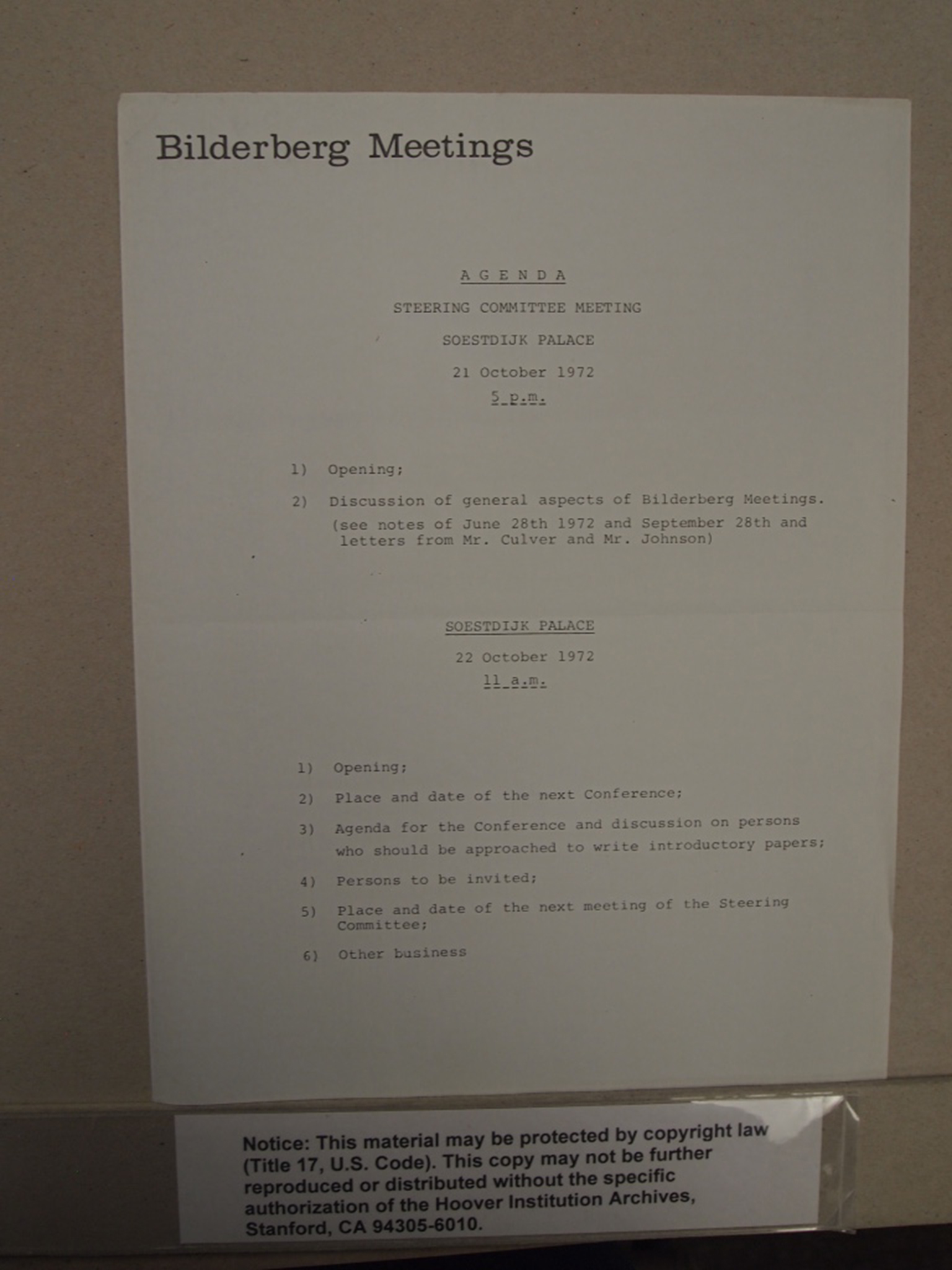
A meeting of the Bilderberg Steering Committee was held at the Soestdijk Palace on 21-22 October 1972 to discuss who to invite to the meeting and what to put on the agenda.[2]
Participants
Among the 1973 participants were Gerrit Wagner, the CEO of Shell, and of the other oil majors: British Petroleum (BP), Total S.A., ENI, Exxon, as well as significant banking interests and individuals such as Baron Edmond de Rothschild and David Rockefeller.

Henry Kissinger
The presence or absence of Henry Kissinger, then US Secretary of State, in Saltsjöbaden has been a matter of some confusion, and is of importance as regards the claim that the 1973 Oil Shock was planned at the meeting. His name is on a memorandum from the Bilderberg’s US Secretariat containing the United States’ proposed list of guests,[3] but he decided not to attend,[3] and is not on the official guest list[1]. Kissinger decided not to attend based on advice from diplomats located in Sweden. Swedish Prime Minister Olaf Palme was staunchly opposed to U.S. war in Vietnam, which was largely orchestrated by Kissinger. "Under these circumstances, it is obvious that my attendance at the Bilderberg Conference would be impossible, and I therefore have decided to cancel my participation," Kissinger wrote in a letter dated April 28, 1973.[4]
William Engdahl has been inconsistent in his claims on this point.[3] Authors including Andrew Gavin Marshall have cited Engdahl on this point, apparently unaware that he is mistaken.[5]
Agenda
1. The Possibilities of the Development of a European Energy Policy and the Consequences for European-North American Relations
The paper noted "the continued requests for price increases from Middle East producing countries, accelerated by the devaluation of the dollar."[1]
Ensuing discussion
The discussion is reported as follows:[1]
- Nature and Scale of the Energy Problem
- What Can Be Done about the Supply Situation?
- The geopolitical background in the Middle East
- Negotiations with the producing countries
- Transforming our relations with the Arab states
- Sharing available supplies
- Alternative sources and forms of energy
- What Can Be Done about the Demand Situation?
- The validity of consumption forecasts
- Economic, political and social aspects of demand reduction
- Avenues towards better fuel economy
- The Monetary Impact of the Oil Crisis
2. Conflicting Expectations Concerning the European Security Conference
This topic had two working papers, one by a Norwegian, one by an American.
The American working paper noted "The continued requests for price increases from Middle East producing countries, accelerated by the devaluation of the dollar. The international oil companies might wage a rear-guard action, but in the end they would yield rather than risk interruption of supplies. They believed it was up to the economies of the consuming countries to absorb these price increases."[1]
Context
Five months after the meeting, the Yom Kippur War brought extensive rises in the price of oil, triggering the 1973 Oil crisis. Various commentators have suggested that this may not have been a coincidence. Sheikh Yamani has stated that he "is 100% sure that the Americans were behind the increase in the price of oil" in 1973.[6]
Early death
In 1975, Paul Stehlin died after being hit by a bus.
References
- ↑ 1.0 1.1 1.2 1.3 1.4 File:Bilderberg-Conference-Report-1973.pdf
- ↑ https://q.publicintelligence.net/wp-content/uploads/2016/07/BilderbergSteeringCorrespondence1972_Page_08.jpg
- ↑ 3.0 3.1 3.2 https://www.lobster-magazine.co.uk/free/lobster76/lob76-bilderberg-myths.pdf
- ↑ https://nltimes.nl/2024/01/02/declassified-papers-detail-wwii-scandals-kissengers-bilderberg-rejection-cheese-study
- ↑ http://www.globalresearch.ca/controlling-the-global-economy-bilderberg-the-trilateral-commission-and-the-federal-reserve/14614
- ↑ http://www.deepblacklies.co.uk/bilderberg_blurb.htm